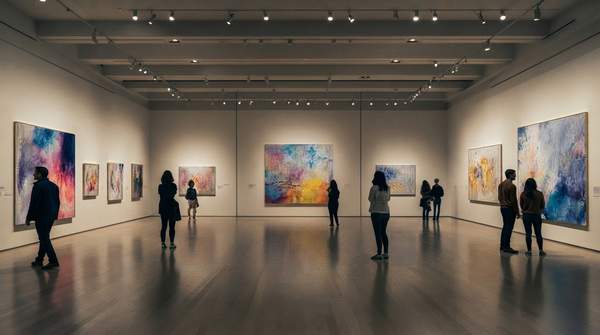
In a dramatic reshaping of the global art market, Gen Z has emerged as the highest-spending generation of collectors, driven by significant family wealth and a distinct preference for privacy. According to the 2026 Art Basel and UBS Survey of Global Collecting, released today, high-net-worth individuals from this younger cohort are now spending more than twice as much on fine art as their Millennial, Gen X, and Baby Boomer counterparts, signaling a profound intergenerational shift in financial power and collecting habits.
The report, produced by Arts Economics, surveyed 3,100 high-net-worth individuals with over $1 million in assets who are active in the art market. It found that during 2025 and the first half of 2026, Gen Z collectors not only outspent other generations but also dominated the top end of the market. The survey revealed that this group accounted for nearly half of all collectors who purchased artworks priced above $1 million in 2026.
The Gen Z Art Collector: A Profile
The survey's findings paint a detailed picture of a new dominant force in the art world, characterized by immense spending power, deep-rooted family influence, and a modern approach to acquisition that blends digital research with a desire for discretion.
Spending Power
The financial impact of Gen Z is stark. In the first half of 2026 alone, their average spending on fine art reached $328,880, according to the survey. This figure eclipses that of other generations, which included $155,530 for Baby Boomers and $122,410 for Millennials. This spending is not just frequent but is concentrated at the highest value levels, cementing their status as the market's new power brokers.
Primary Motivations
Unlike collectors who come to the market independently, Gen Z's journey is overwhelmingly shaped by family. The survey identified family as the most common route into collecting for 40% of Gen Z respondents, compared to just 28% of collectors overall. This connection often begins with encouragement from a family member or direct experience with a family collection. The report notes that nearly 90% of those who inherited artworks chose to keep them. This dynamic points to a significant intergenerational wealth transfer fueling their purchasing activity, as observed by market analysts.
Key Behaviors
Despite their financial might, Gen Z collectors exhibit a strong preference for privacy, a trend described as "quiet luxury." The survey found they are the most private generation regarding who sees their collections, both in person and online, with many choosing to keep their acquisitions off social media platforms like Instagram. Their top concern in the art market was the security of their personal and financial data. This discretion is paired with diligent preparation; 80% of Gen Z collectors conduct significant independent research before buying art, increasingly using digital sources and AI-enabled tools to inform their decisions. While digitally savvy, their tastes often begin with traditional media, with paintings being a common starting point for their collections.
Market Implications: Reshaping the Art World
The ascent of the Gen Z collector is sending ripples through the art market, forcing galleries, dealers, and auction houses to adapt to a new set of expectations. Noah Horowitz, the CEO of Art Basel, stated that the survey points to a collector base that is "increasingly informed, digitally engaged, and active across categories and channels." He noted that Gen Z collectors "bring a new set of expectations and behaviors that will influence the way the collectors of the future engage with the art market."
This new cohort's reliance on digital research tools challenges traditional dealer-client relationships, placing a greater emphasis on transparency and data security. Furthermore, their preference for private engagement over public display suggests that social media-centric marketing strategies may become less effective. The market is also seeing a growing sophistication in Asia, where collectors in Mainland China, Hong Kong, and Singapore are among the most research-driven globally, according to Adrian Zuercher of UBS Global Wealth Management. Mainland China recorded the highest buying intentions of any market surveyed, with 53% planning to acquire art in the next year.
Adapting to Gen Z's Influence: A Path Forward for the Art Market
The findings of the 2026 survey make it clear that the art market's future is tied to its ability to understand and cater to its new leading clientele. For dealers, galleries, and institutions, the path forward requires a strategic pivot. Art market participants, including dealers and galleries, should strategically adapt their engagement methods to align with Gen Z's preference for digital research, family influence, and desire for privacy. Success will likely depend on creating more discreet, personalized, and digitally sophisticated avenues for engagement that respect this generation's values while still showcasing the enduring appeal of traditional art forms.
The key measurable indicator of this adaptation will be the increased adoption of discreet, personalized digital engagement strategies and a sustained focus on traditional art forms by galleries and dealers, reflecting a market that has successfully evolved to meet the demands of its new leaders.
Sources
- ArtDependence
- From AI to Gen Z: Everything to know about the 2026 Survey of Global Collecting — Art Basel
- The Art Basel and UBS Survey of Global Collecting 2026 reveals Gen Z as the highest-spending generation — Prnewswire
- Gen Zers are now the biggest spenders in the art market, survey finds — CNBC
- The Art Basel and UBS Survey of Global Collecting 2026 reveals Gen Z as the highest-spending generation — Prnewswire
- Wealthy Gen Zers’ quiet love of art collecting, revealed — Fortune
- The Art Basel and UBS Survey of Global Collecting 2026 — Contemporary Art