You do not need a fortune to begin collecting art. According to Masterworks Research, a fine-art market commentary team, you can start collecting "for a few hundred dollars" by buying limited edition prints, photography, works on paper, or pieces by emerging artists—sourced through online platforms, local fairs, open studios, and the occasional charity auction. The trade-off is equally clear: experts caution that art has lagged stocks as an investment in recent years, and that most collectors should not expect exceptional financial returns. The three most accessible entry points are compared below, along with the due diligence steps that apply to whichever you choose.
Starting Your Art Collection: Accessible Entry Points
The first decision is not which artist to buy, but which channel to buy through. Art advisors interviewed by CNBC recommend starting locally: visiting galleries and fairs, meeting artists, and building knowledge before spending anything. The market at this level divides into three practical routes—limited edition prints, original works by emerging artists at fairs and community galleries, and photography or works on paper. Each carries a different cost profile, a different kind of risk, and a different relationship to the question of future value. Composition Gallery, in a practical guide for new collectors, adds a preliminary discipline: set aside a specific art fund so that passion does not lead to financial overreach.
Limited Edition Prints: An Accessible Gateway
Prints are the classic first purchase because they carry an artist's name at a fraction of an original's price. Unlike one-of-a-kind works, a limited edition print is one of a fixed number of impressions, and Masterworks Research identifies editions and their pricing as one of the defining features of collecting at the low end. The crucial practical consequence is authentication: a print's authenticity is verified through the artist's signature and its edition numbering, which together confirm that the piece belongs to the declared run. That verification structure is also what makes prints approachable for newcomers—an original work on canvas requires judgment about the hand of the artist, while a signed and numbered print offers a documentary check that a first-time buyer can perform with confidence.
Discovering Emerging Artists at Fairs and Galleries
Art fairs and community galleries are where new collectors encounter artists whose reputations—and prices—are still forming. Composition Gallery notes that local fairs and community galleries often host emerging artists and offer unique pieces at lower prices than major auction houses, and CNBC reports that prices at this tier can start as low as a few hundred dollars. The medium you find depends entirely on the artist's practice: painting, drawing, mixed media, or sculpture may all appear. But this channel carries a distinct risk that a source quoted by CNBC puts bluntly: "An artist can sell out every gallery exhibition and still have virtually no resale market." The same advisor's counsel—"don't believe in popularity. Instead, check if an artist has an auction market"—is the single most useful test before buying from an unknown name.
Photography and Works on Paper: Diverse and Attainable
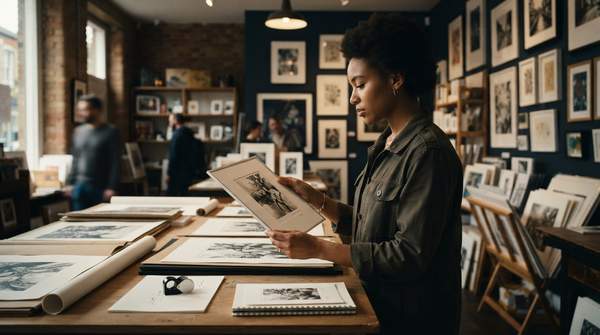
The third route is a category rather than a venue. Masterworks Research lists photography and works on paper alongside prints and emerging-artist pieces as one of the accessible entry routes into collecting, and CNBC's reporting frames the same spectrum—prints and works on paper on one end, higher-priced originals on the other. Works on paper encompass drawings, watercolors, and editioned photographs, and they tend to sit at the lower end of the price range because paper supports smaller scales and, in the case of photography, editioning. The trade-off is material fragility: paper is more vulnerable to light, humidity, and handling than canvas, which makes the care steps in the checklist below especially consequential for this category.
Comparing Entry Points for Budget Art Collectors
The table below compares the three channels across consistent criteria: what you are buying, what it typically costs, and what goal it realistically serves. Reading it this way makes the central trade-off visible—lower cost correlates with less certain resale value, not with a better or worse purchase.
| Acquisition Channel | Typical Cost | Type of Art | Primary Goal |
|---|---|---|---|
| Limited edition prints | Entry level—collecting can start at a few hundred dollars | Printed editions, including works by renowned artists; distinct from one-of-a-kind originals | Personal enjoyment; authenticity verified by signature and edition numbering |
| Emerging artists (fairs/galleries) | From a few hundred dollars at local fairs and community galleries | Original works; medium depends on each artist's practice | Enjoyment with speculative potential—resale market may not exist even for popular artists |
| Photography & works on paper | Lower end of the accessible range | Drawings, watercolors, editioned photographs on paper supports | Enjoyment; requires extra care given paper's fragility |
The comparison reveals the pattern: all three channels can begin in the few-hundred-dollar range, but only the emerging-artist channel offers any plausible path to appreciation—and, as the auction-market caution shows, that path is unreliable. For prints and works on paper, enjoyment is not a consolation prize; it is the rational primary goal.
Collecting for Passion, Not Just Profit
The expert consensus across sources is unusually aligned on motivation. CNBC reports that art has lagged stocks in recent years and that experts caution most collectors against expecting exceptional financial returns; Masterworks Research echoes this, advising buyers to "set a budget you can spend without expecting it back" and to "buy what you genuinely want to live with." This is not pessimism about art—it is a realistic framing of what a few hundred dollars buys. At entry-level price points, the works most likely to appreciate are precisely those with established auction markets, which tend to be out of reach. A collection built for love can still be built intelligently, and the final section below is how.
Essential Due Diligence for First-Time Buyers
Masterworks Research prescribes three checks before any entry-level purchase, and they apply across all three channels:
- Verify authenticity. For prints, this means confirming the artist's signature and edition numbering match the declared edition. For originals by emerging artists, ask for documentation of provenance directly from the artist or gallery.
- Assess condition. Inspect the work—or ask for a condition report—before paying, since condition at purchase is the baseline for everything that happens afterward.
- Plan for care after purchase. Proper framing and storage protect the work from light, humidity, and handling damage; for photography and works on paper, this step determines whether the piece survives intact.
Making Your First Confident Art Purchase
Before making a purchase, thoroughly verify the artwork's authenticity, assess its condition, and plan for proper care and storage to protect your acquisition. The measurable standard is concrete: you should hold a confirmed provenance document or, for prints, the artist's signature and edition numbering, and have a clear understanding of the artwork's physical state and care requirements before money changes hands. A first purchase that satisfies those checks—made within a preset fund you can spend without expecting it back—achieves what budget collecting can genuinely deliver: a work you want to live with, protected from avoidable loss.
Sources
- How to Start an Art Collection on a Budget — Masterworks Academy
- How to start an art collection on any budget — CNBC
- How to Start an Art Collection on a Budget: A Practical — Composition Gallery