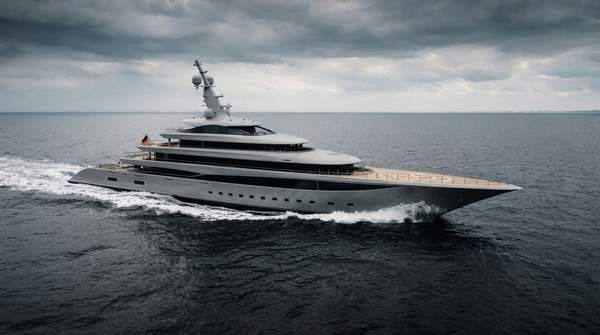
On a superyacht, comfort is not a feature bolted on at the end of a build. It is an engineered system. Climate control and air purification aboard yachts over roughly 25 meters are typically built around a chilled water architecture, in which a central chiller plant cools fresh water that is pumped through insulated piping to air handlers placed throughout the vessel. Those air handlers, working with multi-stage filtration, sterilization, and humidity control, transform raw sea air into the quiet, clean, temperature-stable air owners and guests experience in every cabin and saloon.
The Integrated Challenge of Superyacht Climate Control
The defining idea in modern yacht design is that comfort parameters do not live in isolation. As Think.green's analysis of onboard comfort technology explains, thermal control, lighting, acoustics, vibration damping, air quality, humidity, and water purity "collectively define the living environment," and their interaction must be considered in naval architecture from the earliest stages of a project. Every solution consumes power, occupies volume, requires maintenance, and can create dependencies on specific suppliers.
This systems view explains why a superyacht's air strategy is decided long before interiors are fitted. An air handling unit hidden behind a bulkhead affects generator sizing, fuel endurance, sound insulation, and even the layout of guest decks. A technology that manages several parameters through shared infrastructure, the same analysis notes, can deliver greater systemic value than any standalone improvement.
Primary HVAC Architectures: Chilled Water Systems Explained
Marine air conditioning offers several options, including direct expansion and self-contained units, but for boats over 80 feet (25 meters) the chilled water approach is generally considered the right fit, according to Yachting Pages' technical overview. The architecture is elegantly simple in principle: fresh water is pumped through a chiller via an insulated piping loop, and that chilled water then passes through air handlers located throughout the vessel.
The advantage of this layout is distribution. Because the working fluid is water rather than refrigerant, air handlers can be placed virtually anywhere on board, and each can be outfitted with individual controls to maintain zone-specific temperature and humidity levels. A central plant serves many zones without long refrigerant runs to every cabin.
The trade-off is inherent to the design: a single chilled water loop tends to operate at one water temperature, which can make it harder to satisfy highly varied thermal demands in different zones at the same moment. Industry commentary in ONBOARD Magazine reflects the market's priorities here, noting that builders and consumers demand reliable, quiet systems with less energy consumption in the smallest possible package.
Superyacht Air Path: From Sea to Sanctuary
Tracing a single breath of air through the system reveals how many distinct jobs happen in sequence. The table below follows that path, stage by stage, from the moment outside air enters the system to the moment treated air reaches a guest cabin.
| Stage | Function | Key technology |
|---|---|---|
| 1. Air intake | Regulates the mix of outdoor and recirculated air entering the system | Intake dampers; hygienic air handling units call for Class L1 airtightness |
| 2. Pre-filtration | Retains coarse and medium particles | Pre-filters and secondary filters (F7–F9 classes), protecting downstream stages |
| 3. Primary conditioning | Heats or cools the air to setpoint | Heating and cooling coils fed by the chilled water loop |
| 4. Humidity control | Adds moisture without introducing microbes | Clean steam humidifiers in hygienic designs |
| 5. Sterilization | Disinfects the airstream and internal components | UV-C lamps inside air handling units and ducts, irradiating coils and condensate pans |
| 6. Final filtration | Absolute filtration of remaining particles | Terminal HEPA/ULPA filters within the unit or at the room outlet |
| 7. Zoned delivery | Distributes treated air to each cabin and saloon | Air handlers with individual zone controls; EC fans that compensate as filters load |
The sequence matters as much as the components. Coarse filtration first protects the finer, more expensive downstream filters; sterilization positioned inside the air handling unit, where air velocity is lowest, treats both the airstream and the damp coils and condensate pans where microbes would otherwise grow. FTM Technologies' description of hygienic air handling unit design also notes practical details that translate directly to marine service: smooth stainless steel interiors, thermal bridge breaks in the casing, and double-sloped condensate trays to prevent standing water.
Advanced Air Purification Technologies
Filtration is only half the purification story. UV-C disinfection, supplied to ventilation systems by firms such as FläktGroup for over 15 years, is designed to help prevent the transmission of bacteria and viruses; the company describes its design as tested to eliminate over 90 percent of viruses in the airstream. ASHRAE's technical guidance on UV air treatment explains why the air handling unit is the most common installation point: it treats air from many spaces at once and can simultaneously irradiate cooling coils and condensate pans, with in-duct systems typically designed around an air velocity of about 500 feet per minute.
Ionization offers a complementary approach, particularly for odor control. Dometic's Breathe Ionizer, launched as an accessory for marine climate control systems, is designed as a universal addition to existing installations: boaters drill holes in the airflow path, insert brush grommets, and route power to the unit for purified, odor-free air.
Onboard air quality systems can also be connected to the yacht's own monitoring infrastructure. SuperYacht Times, reporting on air purification aboard yachts, describes a system with low energy consumption that connects to the ship's power (220V/24V) and reads out air quality over a modbus connection, with a stand-alone option available to clean individual areas and rooms.
Engineering for the Marine Environment
Every stage above is hardened for life at sea. Yachting Pages quotes Chip Van Gunten, sales application director at Technicold, advising owners to ensure their HVAC professional recommends "a system that is built to withstand heavy duty usage in a marine environment," adding that even a costlier initial system pays off in "the long term value of clean, reliable air." The same source highlights details like deep insulated condensate pans, properly plumbed to prevent water damage to the vessel, and rotatable blowers for flexible installation.
Heinen & Hopman, a marine HVAC specialist, describes sound and space, efficiency, and the environment as key factors in its system development, including the integration of active bacteria and virus removal filters. Refrigerant strategy is another marine-specific concern: ONBOARD Magazine reports that a well-executed retrofit to lower-GWP refrigerants can improve energy efficiency with few modifications to existing plant, though reclaimed high-GWP refrigerants may become scarce and expensive as manufacturing is cut back.
Ensuring Optimal Onboard Comfort and Health
For owners and designers, the takeaway is to treat climate control and air purification as one integrated, marine-specific system rather than a collection of appliances. The evidence points to a clear decision path: specify a chilled water architecture suited to the vessel's size, demand hygienic air handling construction with multi-stage filtration and sterilization, and insist on marine-grade durability, quiet operation, and energy efficiency from the earliest design stages.
The measurable indicators of success are concrete: consistent, quiet operation of the climate control system, the absence of odors or airborne irritants, and effective air quality management readable through the yacht's own monitoring systems. Those are the observable outcomes that show the engineering beneath the deck is doing its work.
Sources
- 🌊 Superyacht: Behind the Scenes of Comfort Technologies - Think.green
- Superyacht Climate Control: Essential AC Systems — Yachting PAGES
- Superyacht HVAC | On board heating, ventilation & air-conditioning — ONBOARD Magazine
- AHU for Cleanrooms: Design and Installation — FTM Technologies
- Germicidal uvc for hvac — Flaktgroup
- ASHRAE
- Dometic launches an innovative accessory that easily purifies air onboard vessels — Dometicgroup
- Air purity aboard your yacht — SYT
- Yachting — Heinen & Hopman