Most supercars need speed before they can grip: wings and splitters only press a car into the tarmac once air is flowing over them fast enough. The McMurtry Spéirling breaks that rule. Its fan-based system generates enormous downforce at any speed—including a complete standstill—something conventional aerodynamics and even the fan-equipped Gordon Murray T.50 cannot match. The trade-off is power consumption, weight and complexity, which is why this technology lives almost exclusively in extreme track-focused machines.
The Physics of Fan-Assisted Downforce: The McMurtry Spéirling Case Study
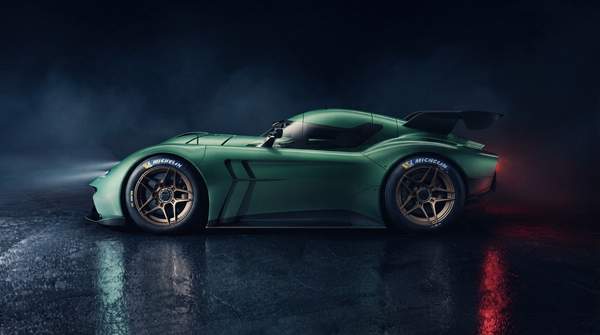
The Spéirling, a compact electric track car built by British firm McMurtry Automotive, abandons the conventional recipe of big wings and underbody tunnels. Instead, it uses two high-speed fans to extract air from a sealed area beneath the chassis. With less air remaining under the car, the body is pressed down against the road with a force the driver can exploit as grip.
The numbers are striking. McMurtry says the production-form Spéirling PURE can generate up to 2,000 kilograms (4,409 pounds) of downforce from zero miles per hour—more downward force than the car itself weighs, before it has even moved. The company brands this capability "Downforce-on-Demand," and describes its fans spinning at 23,000 rpm to provide constant downforce through all corners, letting drivers take unconventional lines through turns.
The consequences reach beyond lap times. Because the grip does not depend on forward speed, the Spéirling can accelerate, brake and turn with significantly more traction than other hypercars, especially at low speed, where rivals' aerodynamic surfaces are still generating almost nothing. McMurtry notes that Formula 1 cars could theoretically drive upside down at speed due to their downforce, but nobody had attempted it—until the company demonstrated its own car driving upside down from stationary, a feat possible precisely because its downforce exists without motion.
That is the fundamental distinction. A conventional wing is a passive device: its output scales with velocity. A fan is an active device, powered like any other onboard system, and its output is available on tap regardless of what the car is doing.