A bespoke leather item is built in four broad stages—design and pattern making, precision cutting and edge preparation, hand-stitched assembly, and finishing—and the techniques that define its quality are saddle stitching and hand-burnished edges. According to artisans who document their own workshops, hand-stitched saddle stitching with waxed thread delivers superior strength and longevity compared with the machine stitching used in factory production, while hand-burnished, waxed and polished edges protect the leather and refine its appearance. Understanding these stages lets a connoisseur read construction details the way a jeweler reads a setting.
The Essence of Bespoke Leather Craftsmanship
Bespoke leather goods are, by definition, custom-made: tailored to the specific needs and preferences of the customer rather than produced in volume. That is the definition offered by Peter Smith of PS Leather Craft UK, a bespoke maker, who describes artisans taking the time to understand a customer's style and requirements before creating a one-of-a-kind piece, from wallets and bags to shoes and jackets.
What separates this work from ordinary manufacturing is not merely customization but the accumulation of hand skills at every stage. Old Town Leather Goods, a workshop writing on its own craftsmanship, frames the process as one passed down through generations, blending traditional techniques with modern innovation, where each step from initial design concept to final finishing reflects the dedication and expertise of skilled artisans. The result, they argue, is luxury leather goods built to last a lifetime.
Stage 1: Design and Pattern Making
Every piece begins with a design that balances function and form. Maharya, an Indian leather manufacturer whose workshop walkthrough was written by Navin Sehgal, gives concrete examples: a crossbody bag demands lightweight construction, while a travel duffel needs reinforced handles and sturdy zippers. The design decisions are therefore structural, not aesthetic alone.
The pattern itself is drawn on specialized paper or CAD software, then transferred onto the leather. Maharya identifies this stage as the source of precision in craftsmanship—what it calls a vital factor in luxury leather manufacturing. In bespoke work, the pattern is also where the customer's specific requirements are translated into measurable cuts and seam lines before any leather is touched.
Stage 2: Precision Cutting and Edge Preparation
With patterns ready, artisans cut each piece using razor-sharp knives, dies, or laser-cutting machines. Maharya notes that unlike mass production, handcrafted bags are cut with care to minimize waste and preserve the natural beauty of the hide. Each cut is then inspected, and pieces are matched for color and grain consistency so the finished item presents a seamless, harmonious look.
Edge preparation follows. Depending on the design, artisans bevel, burnish, or paint the edges for durability and style. This stage also involves skiving—thinning certain sections of the leather so they fold neatly during assembly. Maharya characterizes this painstaking work as what separates high-quality bags from mass-produced ones, since it ensures every small detail meets the maker's standard.
Stage 3: Hand-Stitching and Assembly
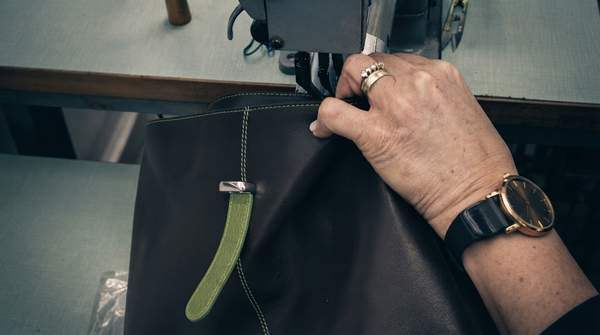
Assembly is where the durability argument becomes concrete. Old Town Leather Goods contrasts factory-produced goods that rely on machine stitching with hand-stitched wallets and bags that use traditional techniques like saddle stitching, a method they say provides superior strength and longevity.
Their explanation of why saddle stitching is superior rests on specific properties: it uses a waxed thread that resists fraying and wear, it ensures even tension throughout the seam and so prevents weak points, and it provides a more refined, durable finish than machine stitching. Duret Paris, writing on luxury bag construction, frames assembly as a domain where every stitch must combine strength and aesthetic appeal—though their account also credits machine stitching with exceptional precision and perfect consistency of each stitch, a reminder that workshops differ on where the hand's value lies.
Stage 4: The Art of Finishing Touches
The final stage involves techniques that protect and enhance the product's appearance. Old Town Leather Goods lists three essentials: edge burnishing, which smooths and seals raw edges for a polished look; beeswax conditioning, applying natural wax to enhance suppleness and durability; and hand polishing, buffing the surface to achieve a deep, natural shine. Together, they argue, these techniques ensure luxury leather accessories maintain their elegance and functionality for years.
Duret Paris describes a parallel finishing discipline on bag contours: applying multiple layers of specialized dye before gently polishing, carried out by hand, to create a soft touch and a seamless finish. Finishing is thus both protective and aesthetic—the stage where the leather's surface and edges are sealed against wear and given their final character.
Artisanal vs. Mass-Produced Leather: A Craftsmanship Comparison
The table below juxtaposes the artisanal techniques described by these workshops against their common mass-production counterparts at each key stage, isolating what craftsmanship contributes to durability and finish.
| Process Stage | Bespoke/Artisanal Method | Common Mass-Produced Method | Resulting Quality Difference |
|---|---|---|---|
| Overall production | Custom-made to the customer's specific needs and preferences | Standardized items made in volume | A one-of-a-kind piece tailored to the individual, per PS Leather Craft UK's definition |
| Design and pattern | Patterns drawn on paper or CAD, transferred to leather with precision | Standardized patterns replicated at scale | Precision and consistency Maharya calls vital to luxury manufacturing |
| Cutting | Cut with care to minimize waste and preserve the hide's natural beauty; pieces matched for color and grain | Volume cutting without individual inspection and matching | A seamless, harmonious look across the finished piece |
| Edge preparation | Beveling, burnishing, or painting edges; skiving sections to fold neatly | Edges typically finished quickly at scale | Smoother, more durable edges—work Maharya says separates high-quality bags from mass-produced ones |
| Stitching | Saddle stitching with waxed thread and even tension throughout | Machine stitching relied on in factory production | Superior strength and longevity: waxed thread resists fraying and wear, and even tension prevents weak points, per Old Town Leather Goods |
| Finishing | Edge burnishing, beeswax conditioning, hand polishing; layered hand-applied dye | Rapid surface treatment at scale | Sealed, polished edges and a deep natural shine that maintains elegance and function for years |
Read down the final column and a pattern emerges: at every stage, the artisanal method substitutes time and inspection for speed. The comparison is drawn from workshops describing their own processes, so it reflects their stated value propositions rather than independent laboratory testing.
Why Handcrafted Endures: Value and Durability
The durability case rests most heavily on stitching. Old Town Leather Goods attributes the superior strength and longevity of saddle stitching specifically to the waxed thread's resistance to fraying and wear and to the even tension that prevents weak points—claims about the technique's mechanics, not measured test results. Duret Paris adds the aesthetic dimension: a seam where every stitch combines strength and visual appeal.
Finishing completes the argument. Burnished and sealed edges, beeswax conditioning, and hand polishing are described by their practitioners as the techniques that keep luxury accessories elegant and functional for years. Value, in this account, is not a logo but the accumulated effect of decisions made at the bench—matched grain, skived folds, knotted tension, waxed edges. Specific steps vary by artisan and product type, so this is a general map of the craft rather than a universal recipe.
Identifying True Craftsmanship in Leather Goods
When evaluating luxury leather goods, prioritize items that explicitly detail the use of traditional hand-crafting techniques such as saddle stitching and hand-burnished edges, as these indicate superior durability and aesthetic quality. The measurable indicator: look for visible evidence of saddle stitching—individual, slightly angled stitches—and smooth, sealed, or polished edges without visible layers or peeling paint. An item that shows both has the construction details these workshops identify as the mark of the hand rather than the machine.
Sources
- The Art of handmade leather craftsmanship: A Journey of Craftsmanship — Handmade Quality Leather Bag,Leather Accessories
- The Art of Crafting Bespoke Leather Goods — PS Leather Craft UK
- Handcrafting Leather Bags: Step By Step -Maharya
- The crafting secrets behind a luxury leather bag - Duret Paris