Haute couture embroidery is not one craft but a family of techniques, and the two most instructive to compare sit at opposite ends of the tool spectrum. Tambour, also called Lunéville or Broderie d'Art, builds every stitch with a fine handheld hook. The technique known as 'Al Aire', by contrast, uses an antique sewing machine—yet is still classified by practitioners as hand embroidery. Understanding how each method works, and where it is applied, is the clearest way into the craft.
Introduction to Haute Couture Embroidery
At its finest, hand stitching for fashion operates at what Hand & Lock describes as "the finest and most technically advanced levels of hand stitching," adding crystal work, beading and textural depth through metal threads, silks and beads. The design is fitted to a pattern piece before a single stitch is made, which is what separates couture embroidery from decorative surface stitching on a finished garment.
Within that world, the Dutch Couture Academy distinguishes at least two families of technique. Broderie d'Art—the tambour or Lunéville hook tradition—is the most recognized. 'Al Aire', meanwhile, is "a completely different technique than what we know as 'Broderie d'Art'," the academy notes, with its own character and applications. Comparing the two reveals how a tool choice shapes the final garment.
Tambour/Lunéville Embroidery: The Hand-Hook Method
Tambour embroidery arrived in France through a long route. According to Textile Tours of Paris, Chinese silk embroiderers developed a technique using a frame and a hook, which travelled across India and the Ottoman Empire before reaching France through the port of Marseilles in the late 18th century. At the Royal Court it was embraced by Madame Pompadour, official mistress of King Louis XV, and became known as the Point de Pompadour. By Hand London adds that the earliest examples were imported to France and England from places such as India and China, and that the technique is named for the drum-shaped frame—"tambour" being the French word for drum.
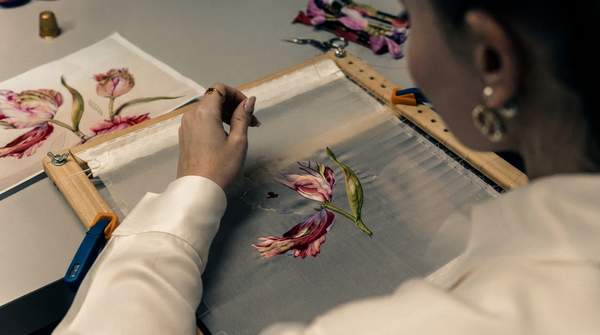
The method itself is strikingly economical: there is only one stitch, the chain, worked with a fine sharp hook instead of a needle. The hook is punched through tightly stretched fabric to catch the thread and draw it up, creating a smooth, continuous chain stitch. In haute couture, the Dutch Couture Academy explains, tambour is often used to quickly and precisely attach beads, sequins and tubes—especially where a design calls for long lines, controlled curves and repeatability.
The signature challenge is orientation. The embroiderer works from the back of the fabric while beads and sequins are fed from underneath, meaning the design is effectively stitched in reverse. Beginners typically train on sheer silk organza, where the work remains visible through the fabric, before progressing to opaque materials. Hand & Lock frames the same technique as one that elevates a garment by "transforming fabrics into works of breath taking quality" through the Tambour (Luneville) hook.