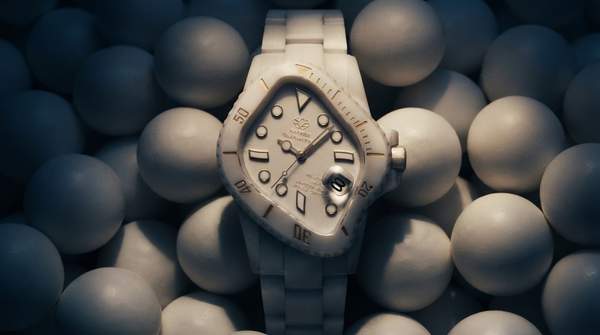
For the collector weighing a modern case material, the decision comes down to a single engineering compromise: surface hardness versus resistance to impact. Ceramic wins the scratch war decisively—watch-grade zirconium oxide registers above 1,200 HV on the Vickers scale, where stainless steel sits between 200 and 350 HV—but that same hardness makes it vulnerable to cracking under a severe blow. Carbon composites invert the equation: they are exceptionally light, strong, and shock-tolerant, yet their hardness, in the case of forged carbon around 800 to 1,200 Vickers, does not match ceramic's scratch-proof surface. Hybrid materials such as IWC's Ceratanium attempt to split the difference, pairing a titanium-like lightness with a ceramic-like hardened surface. Here is how each material behaves, and what that means on the wrist.
Ceramic: Unrivaled Scratch Resistance with a Catch
High-tech ceramic is, by most accounts in the watch trade, the most consequential surface innovation in contemporary case making. As Noah Mackie explains in his materials guide for Noah's Fine Watches & Jewelry, watch-grade ceramic is almost always zirconium oxide, sintered at temperatures above 1,400 degrees Celsius; that process compresses fine powder into a structure registering above 1,200 HV. In practical terms, he writes, a ceramic case surface "will not scratch under contact with keys, metal edges, or anything encountered in daily wear."
The consequences of that hardness extend beyond scratch resistance. Kapoor Watch Co. notes that engineered ceramic is lightweight, color-stable, and immune to fading or oxidation, maintaining its appearance for decades with nothing more than simple cleaning. GrayAndSons makes the same point from the collector's angle: ceramic is nearly four times harder than stainless steel, does not oxidize or corrode, and keeps its glossy or matte finish for years in a way that steel and titanium do not.
The catch is brittleness. Kapoor Watch Co. is direct: while highly resistant to scratches, ceramic "can crack under severe impact." Everest Bands' Ripley Sellers frames the same limitation in the material's physics—hardness and brittleness are two faces of the same property, so the very rigidity that protects the surface concentrates shock rather than absorbing it. A ceramic case that shrugs off a decade of desk dives can chip or shatter from a single hard drop onto tile.