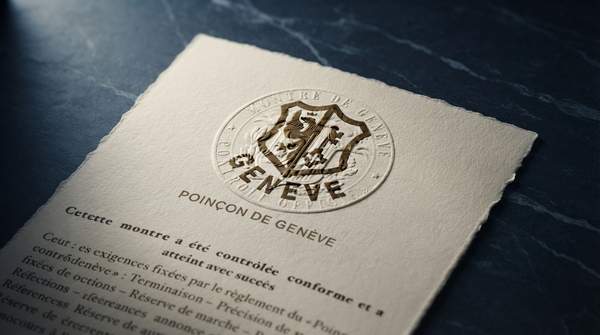
The Poinçon de Genève is an official state guarantee, established by the Grand Council of the Canton of Geneva in 1886, that certifies a watch's Genevan origin and the exceptional finishing of its movement—and, since a major revision introduced by the Timelab Foundation in 2011 and refined in 2013, the performance of the complete, cased-up watch as well. For a buyer evaluating a luxury timepiece, the distinction matters enormously: a Geneva Seal watch certified under the modern rules promises not only hand-finished bridges and polished screw heads but also verified accuracy, water resistance of at least 3 bar, and individually tested functions. Understanding which era of the standard a watch was certified under is therefore the first step in assessing what the hallmark really tells you.
A Legacy of Excellence: The Geneva Seal's Evolution
The Seal was created in 1886 with a precise goal: to preserve the region's watchmaking expertise, as Roger Dubuis recounts in its own account of the certification's history. Initially applied to specific parts of the movement, it functioned above all as a symbol of origin and authenticity for timepieces made in Geneva. For roughly 125 years, the certification's core was craftsmanship and provenance rather than overall watch performance—the aesthetic and technical finishing of movement components, not the behavior of the finished watch on the wrist.
That focus began to change as watchmaking technologies advanced. In 2011, Timelab updated the criteria to encompass comprehensive performance testing for the entire watch, a significant evolution in the certification's history, as Barrington Watch Winders describes. This change responded to customer demand for broader guarantees of quality and precision. The twelve criteria of the Hallmark were then updated again in 2013, according to reporting by Charlie Paris, with the explicit goal of modernizing the certification while preserving traditional expertise—some criteria, the magazine notes, had not changed since 1886. Reliability requirements were further developed in updates through 2014. Today the Seal is managed by the Timelab Foundation, which comprises both a certification department and a research and development department.