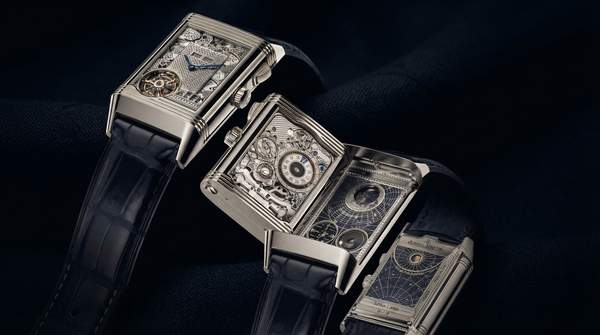
Astronomical complications are the two great families of celestial watchmaking, and they solve very different problems. A moonphase tracks the visual cycle of the moon's illumination over roughly 29.5 days; a perpetual calendar mechanically masters the irregular Gregorian year, adjusting for short months and leap years without being touched. One is poetic and relatively common; the other is a certified "grand complication." Understanding why comes down to the distinct mechanical problems each one poses.
The Celestial Dance: Understanding Astronomical Complications
Astronomical complications reproduce cosmic phenomena in the restricted space of a wristwatch. Jaeger-LeCoultre, whose manufacture has worked on these mechanisms for 190 years, groups them from simple calendar watches and moon phases up to the extreme complexity of perpetual calendars, equation-of-time watches, sky charts, and even draconic and anomalistic lunar cycle displays. The Foundation for High Horology traces the impulse further back: the calendar itself was the first manmade organization of time, deduced by ancient observers from the apparent motion of the Sun and Moon.
What unites these mechanisms is that they are geared approximations of celestial cycles. The moon's phases, the lengths of months, the leap year—none fit neatly into a 24-hour rotation. Every astronomical complication is therefore an exercise in mechanical compromise: encoding an irregular natural rhythm into a train of wheels and levers that advances once per day.
From Grand Clocks to Wristwatches: A History of Miniaturization
The genre began at monumental scale. Moonphase indicators appeared in the 17th century as complications within astronomical clocks, often installed in grand churches or town squares, giving the public a visual reading of the lunar cycle at a time when moonlight mattered for agriculture and navigation. Ulysse Nardin's historians note that monumental astronomical clocks were erected in European cities from the late Middle Ages to render the movement of the stars comprehensible.
Miniaturization moved these displays into pocket watches during the 18th and 19th centuries, but the transition to wristwatches nearly ended the story. As Brandon Moore recounts for SJX Watches, the move to the wrist "almost consigned astronomical complications to history." The contemporary resurgence owes much to one restorer: between 1978 and 1982, Ludwig Oechslin dismantled and reassembled the 472 components of the Vatican's Farnese Clock, returning it to working order—an achievement that helped rekindle interest in celestial mechanics on the wrist.