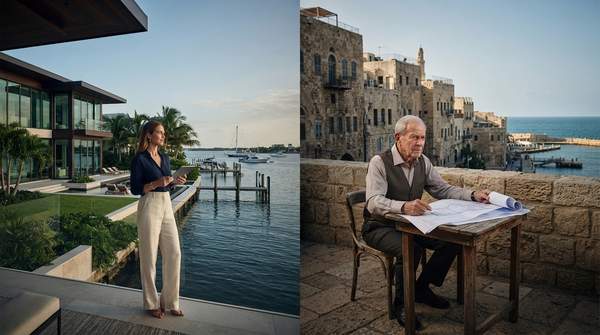
Emerging luxury markets are not all emerging the same way. On Florida's Gulf Coast, Naples and Sarasota have matured into high-volume, price-setting markets where nine-figure sales now close in weeks. In Jaffa, Israel, luxury is arriving through a far older building stock: a walled compound once run by the Maronite Church has been redeveloped into 62 apartments, with a penthouse sold for $10.3 million. For a global investor, the question is not which market is "better" but which model of growth—broad maturation or historically rooted redevelopment—fits your portfolio and lifestyle.
Introduction: Two Paths to Luxury Real Estate Growth
The two markets differ in almost every dimension: scale, product, and the source of value. Naples and Sarasota compete in the conventional sense—on volume, price records, and new construction—drawing buyers who already know Aspen, the Hamptons, or Palm Beach. Jaffa's luxury appeal is quieter and more architectural. Its most visible project, reported by Talia Levy Rosenbaum for ynet, converts a historic enclosed compound into residences while opening its courtyard to the public for the first time. One market is a maturing coastal economy; the other is a single-city story of urban renewal layered onto ancient stone. Comparing them clarifies what "emerging" actually means in each case.
Naples/Sarasota: The Maturing US Coastal Powerhouse
The headline numbers are large. A Naples estate changed hands for approximately $70 million after less than two weeks in private exclusive inventory, following an $86 million Gordon Drive transaction earlier this year. The prior year saw a $225 million sale of an assemblage of 15 Gulf-front acres—breaking all Florida records. In Sarasota, a Gulf-front estate sold for $30.3 million in July of last year, and a Siesta Key property fetched $26 million this September.
Beneath the headlines sits real volume. An analysis of Southwest Florida MLS records identified 73 single-family sales above $10 million in the twelve months ending in August, with the median sale price within that group rising 17.4% to $15.5 million. As the analysis itself cautions, that does not mean every Naples property gained 17.4%—it is a segment-level median, not a guarantee for any individual home. What the volume does show is a market that, in the view of that analysis, now sets its own prices rather than taking cues from the Atlantic coast.
Jaffa, Israel: Historic Redevelopment and Unique Appeal
Jaffa's emerging luxury market is being built stone by stone. Its emblematic project is the former nuns' school in the Ajami neighborhood, a walled complex that once belonged to the Maronite Church. Architect Pitsou Kedem has transformed it into 62 apartments—converting an enclosed, private property into something that engages its surroundings. "Unlike many other sites in northern Jaffa, the story of the Nuns' Compound is about taking an enclosed property and transforming it into a place that creates a dialogue with the neighborhood," Kedem says. The redevelopment opens the compound's gates to the public, and its most consequential sale to date is a penthouse that went for $10.3 million.
The reporting also flags tension: the project raises questions about gentrification and the fate of longtime residents. That is a different kind of risk than a Gulf Coast buyer faces—one tied to neighborhood change and social dynamics rather than to land supply or market liquidity, and worth weighing for any buyer whose thesis depends on the area's continued desirability.
Comparative Overview: Naples/Sarasota vs. Jaffa Luxury Markets
The table below juxtaposes the two markets' defining characteristics. The point of the comparison is not a ranking: it is to show that one market's value is measured in verified sales volume and median-price movement, while the other's is measured in the uniqueness and execution of individual redevelopment projects.
| Dimension | Naples/Sarasota, Florida | Jaffa, Israel |
|---|---|---|
| Market Driver | Broad maturation: 73 single-family sales above $10 million in the 12 months ending August; median in that group up 17.4% to $15.5 million | Architectural and historical redevelopment of specific sites, exemplified by the former nuns' school becoming 62 apartments |
| Recent High-End Sales Data | ~$70 million Naples estate; $86 million Gordon Drive sale; $225 million 15-acre Gulf-front assemblage (a Florida record); $30.3 million Sarasota Gulf-front estate; $26 million Siesta Key sale | Penthouse in the Nuns' Compound sold for $10.3 million; project-level reporting rather than segment-wide volume data |
| Architectural Character | New construction and highly customized homes meeting the expectations of buyers from Aspen, the Hamptons, or Palm Beach; fixed supply of true Gulf-front and bayfront land | Historical preservation blending ancient walled structures with contemporary design, opening formerly private space to the public |
| Investment Profile | High-volume, price-setting market that now moves independently of the Atlantic coast | Character-driven opportunities tied to individual urban renewal projects, with gentrification questions attached |
Read side by side, the table resolves into a choice of models. If your strategy needs liquidity, comparable sales, and a deep buyer pool, the Florida data supports it directly. If your strategy prizes irreplaceability—a walled historic compound that cannot be built again anywhere—the Jaffa model is the one that delivers it, though with thinner market data behind any resale assumption.
Strategic Considerations for High-Net-Worth Investors
A few practical contrasts follow from the evidence. In Naples and Sarasota, the scarcity argument is geographic: no one can build another homesite on Gordon Drive or Longboat Key, and new construction has caught up to the standards of buyers arriving from historic wealth centers. The lifestyle offer—boating, golf, private clubs, and Old Naples accessibility—lets a resident, as the reporting puts it, be private at home without being isolated from a social life. In Jaffa, scarcity is architectural and historical, and the lifestyle is urban and layered into an existing neighborhood, with the openness of the redeveloped compound itself part of the value proposition.
The data asymmetry matters for diligence. Florida's segment metrics allow you to benchmark a target property against 73 comparable ultra-luxury closings; Jaffa's reporting gives you one penthouse price and a project narrative. A serious Jaffa buyer will need project-level due diligence—unit by unit, developer by developer—rather than market-level averages. And the gentrification questions reported around the Nuns' Compound suggest researching neighborhood dynamics before assuming long-term appreciation.
Both markets are based on information reported in late 2026, and this comparison is an overview, not exhaustive financial advice. It covers only the two markets for which evidence was available—Naples/Sarasota and Jaffa—and not, for example, Paradise Valley.
Informing Your Global Luxury Real Estate Strategy
Investors should align their strategy with either high-volume, price-setting markets like Naples/Sarasota or character-driven, redevelopment-focused markets like Jaffa, based on their investment goals and risk tolerance. The Florida path suits buyers who want measurable segment momentum and a liquid upper tier; the Jaffa path suits buyers whose thesis rests on irreplaceable historic architecture and tolerates thinner comparable data. The measurable indicators to watch, respectively, are the continued growth in high-value sales volume for Naples/Sarasota—or the successful completion and market reception of new historical redevelopment projects in Jaffa. Whichever indicator moves first in your next review cycle tells you which model is still earning its premium.